.png)


Back To Blogs
April 3, 2026
Joe Averill
10 minutes
Most articles about office carbon footprints are written for the people who own the buildings. That's not very useful if you don't own yours.
If you're a small business owner, a startup founder, or an office manager at a growing company, you probably lease your space. You can't replace the boiler. You can't decide whether the building runs on renewable electricity. You can't refurbish the lobby with reclaimed materials. And yet your company still has a carbon footprint, your investors and customers still want to see progress on it, and "we don't own the building" isn't going to cut it as an excuse much longer.
So here's the question this guide actually answers: what can you do about your office carbon footprint when you're a tenant, not a landlord? Quite a lot, as it turns out. And one of the easiest answers is choosing the right sustainable workspace in the first place.
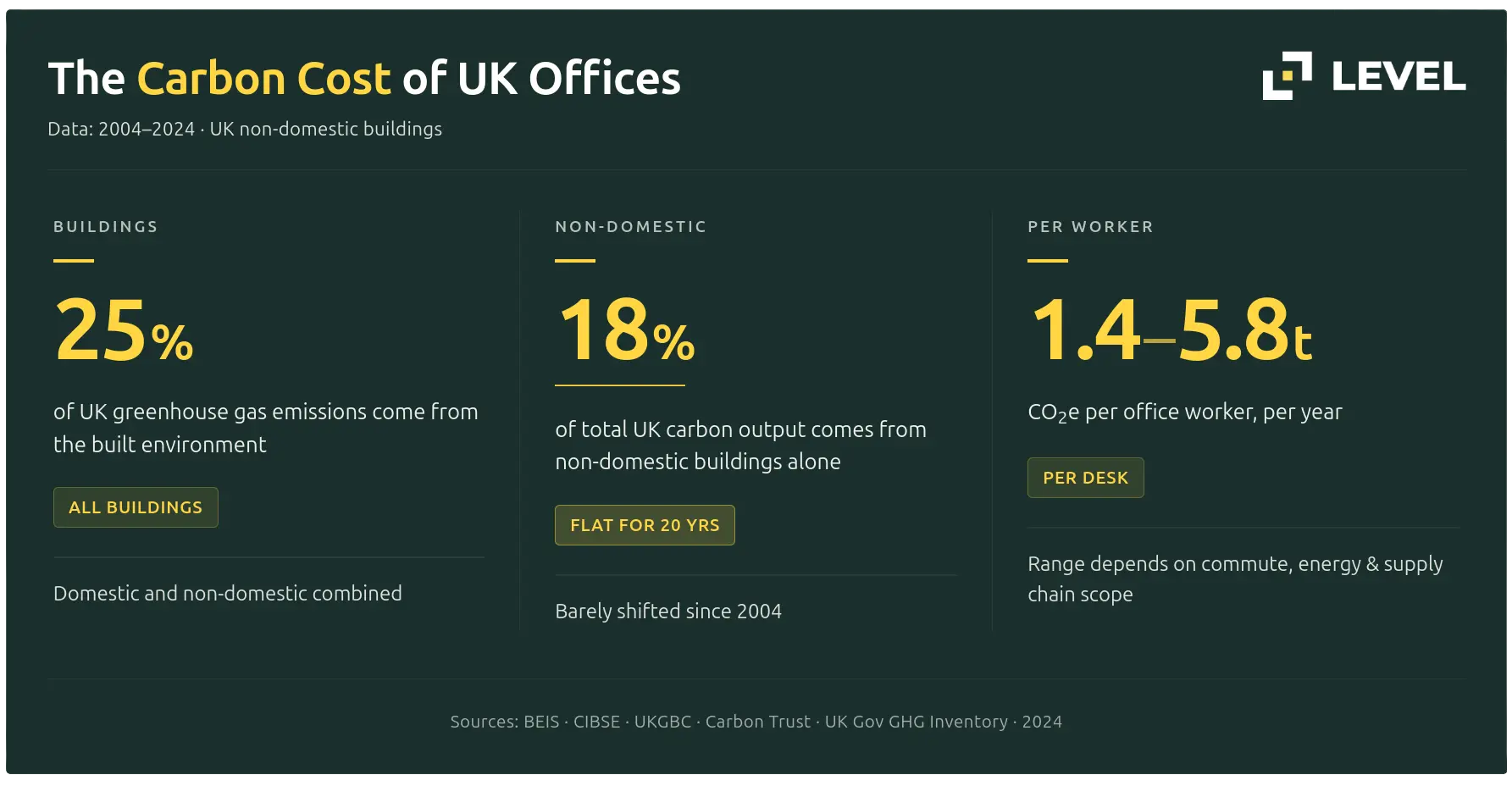
The average UK office worker is responsible for somewhere between 1.4 and 5.8 tonnes of CO2 equivalent per year, depending on how you count things like commuting and supply chains. For a 20-person company, that's roughly 30 to 115 tonnes a year. For 100 people, you're looking at 150 to 580 tonnes.
But here's the thing tenants need to understand: your footprint isn't just one number. It's split between things you control, things your landlord controls, and things that fall somewhere in between.
The takeaway is that you have more influence than you think, especially over the day-to-day stuff and the bigger strategic decisions like which building you choose next time your lease comes up.
The standard framework for measuring corporate emissions is the Greenhouse Gas Protocol, which splits everything into three "scopes." For tenants, the scopes work a little differently than they do for building owners.

Direct emissions you control
For most tenants in a leased office, Scope 1 is small. If your landlord runs the central heating, that gas isn't yours — it's theirs.
Purchased electricity
Usually your single biggest controllable category. If electricity sits in your service charge, ask your landlord for consumption data — or estimate by floor area.
Everything else
Everything you don't burn or buy directly. For office-based businesses this typically dominates the footprint — including, often surprisingly, the heating your landlord provides on your behalf.
Scope 1: direct emissions you control. For most tenants in a leased office, Scope 1 is small. It might include fuel for any company vehicles, refrigerants from a server room cooling unit if you operate one, or gas you burn directly (rare for tenants). If your landlord runs the central heating, that gas isn't your Scope 1, it's theirs.
Scope 2: purchased electricity. This is usually your single biggest controllable category. If you have your own electricity meter and pay the bill directly, that's clearly your Scope 2. If electricity is included in your service charge, it gets messier, and you'll need to ask your landlord for consumption data or use a reasonable estimate based on floor area.
Scope 3: everything else, and it's the big one. For an office-based business, Scope 3 typically makes up around 75% of total emissions. It includes employee commuting, business travel, the laptops and furniture you buy, the catering you order, the cleaning services you contract, and the upstream emissions from the electricity you use. Importantly, the heating provided by your landlord usually shows up in your Scope 3 under category 8 ("upstream leased assets") if you don't directly control or pay for it.
That last point matters. Even if you don't physically control the boiler, the emissions from heating your space are still attributable to your business. You can't dodge them by pointing at the lease.
You can't reduce what you haven't measured. The good news is that for a small or mid-sized tenant, measuring your footprint is much simpler than for a building owner with a whole portfolio.
Start with these basics:
For free tools, the SME Climate Hub has calculators built specifically for small and medium businesses. The Carbon Trust SME Calculator and NatWest Carbon Planner are also free and UK-focused. If you outgrow these, paid platforms like Greenly, Plan A, or Normative offer more depth at a few thousand pounds a year and up.
The standard you'll want to follow is the GHG Protocol Corporate Standard. It's free, globally recognized, and forms the basis for nearly every reporting framework you might eventually need to comply with.
These are the changes you can make tomorrow without a single conversation with your landlord, and they add up fast.
Switch to LED desk lamps and any lighting you control. LEDs use 75 to 80% less energy than traditional bulbs. If your fit-out lets you swap fittings, even better. A typical office can save thousands of pounds a year on lighting alone.
Kill standby power. Office equipment left on standby accounts for up to 10% of total electricity usage. Smart plugs, scheduled shutdowns, and a simple "last person out" checklist can wipe most of this out. Set computers to sleep after 10 minutes of inactivity. It sounds boring, and it works.
Adjust the thermostat by 1 degree. Where you have control over your zone, dropping heating by 1 degree Celsius cuts heating energy by about 8%. Most people don't notice the difference.
Cut paper use. The average office worker still goes through around 10,000 sheets of paper a year, and 68% of it gets wasted. Going mostly paperless with cloud storage and digital signing can reduce paper consumption by up to 75%. Our sustainable office practices guide covers this in more detail.
Fix your recycling. Around 70% of office waste is recyclable, but most offices recycle a fraction of that. Clear signage, properly placed bins, and a five-minute team briefing usually move the needle quickly. If your landlord's waste contractor is the problem, that's a conversation to have (more on that below).
Set procurement defaults. Switch your default coffee, cleaning supplies, paper, and stationery to recycled, refillable, or certified-sustainable alternatives. This is a one-time decision that pays back forever. It also moves the needle on Scope 3, which is harder to reduce in other ways.
Encourage greener commuting. Sign up for the UK Cycle to Work Scheme, which saves employees 25 to 39% on bicycles. Around 209,000 people used it in 2024/25. Swapping one car trip per day for cycling saves roughly 3.2 kg of CO2 per trip, which is half a tonne per commuter per year over 200 working days. EV salary sacrifice schemes deliver similar benefits for people who can't cycle. Our cycle to work and green commuting guide goes deeper.
Rethink business travel. Default to video calls for short internal meetings. When travel is needed, choose train over plane where possible. Set a per-trip carbon budget alongside the cash budget. Flights are often the single biggest chunk of a small company's footprint, so even modest discipline here pays off.
Hybrid work, done thoughtfully. Reducing office days from five to three per week cuts commuting emissions by around 40% per employee. Just be aware that home working shifts emissions rather than eliminating them, so total impact depends on how people heat their homes.
This is the section nobody else writes, because most articles assume you control the building. You don't, but you do have leverage, especially at lease renewal or when signing something new.
Energy data. The single most useful request: monthly consumption data for your space and the building as a whole. You can't manage what you can't see. Reasonable landlords will share this, and increasingly they have to in order to support their own reporting obligations.
A green lease clause. This is a contractual addition where both parties commit to sharing data, cooperating on efficiency improvements, and aligning on sustainability goals. The Better Buildings Partnership publishes a free model green lease template that's widely used in the UK market. Even a light version is better than nothing.
Renewable electricity supply. Ask whether the building runs on a green tariff, and whether the landlord is willing to switch if not. Many UK suppliers now offer REGO-backed tariffs at little or no premium.
Sub-metering. If your space isn't separately metered, ask for it. Without sub-metering, you're guessing at your own consumption.
Sustainable refurbishment standards. When the landlord refurbishes common areas or your space, push for low-impact materials, reused furniture, and a target like the SKA rating or BREEAM Refurbishment. Our sustainable fit-out guide covers what good looks like.
Better waste contracts. If recycling at the building level is poor, raise it with the property manager. Often the issue is that one waste contract covers all tenants, and improvements benefit everyone.
EPC improvements. Ask about the building's current Energy Performance Certificate rating and what plans exist to improve it. Which leads to the next section.
If you're at the start of a lease search, this is the highest-leverage moment in your entire carbon journey. The building you choose now will shape your footprint for years. Here's what to actually look at when evaluating spaces.
EPC rating. Every commercial property in the UK has one. Aim for a B or higher. Avoid anything below a C. Under current MEES regulations, landlords cannot legally let commercial space below an E, and the minimum rises to C by 2027 to 2028 and B by 2030 to 2035. Around 60% of UK commercial property currently sits below EPC C. Choosing a better-rated building now means you're not stuck in a stranded asset when the rules tighten. Our EPC and MEES guide explains how this all works.
BREEAM or LEED certification. These third-party certifications signal that a building was designed and operates to recognized environmental standards. BREEAM is the dominant UK standard. Look for Excellent or Outstanding ratings. BREEAM-certified buildings command 15% higher rents on average, but they also deliver real efficiency: lower bills, better systems, and a building that won't be obsolete in a decade. Our green building certifications guide compares the main options.
Renewable energy in the building. Ask explicitly: is the electricity supply on a renewable tariff? Is there on-site solar? What percentage of building energy comes from renewables? Vague answers usually mean no.
WELL certification or equivalent. This focuses on occupant health and air quality, which overlaps significantly with sustainability and matters for your team's productivity. See our workplace wellbeing guide for why this matters.
End-of-trip facilities. Bike storage, showers, lockers, EV charging. These quietly enable greener commuting and signal that the building actually thinks about sustainability rather than just claiming to.
Smart building tech. Sub-metering, occupancy sensors, smart HVAC controls, building management systems. This is where real energy savings come from in operation. See our energy efficient office buildings guide for what to look for.
The landlord's own commitments. Does the property owner have a public net zero target? Are they reporting under SECR or CDP? A landlord with their own credible climate strategy is a landlord who'll actually engage with yours.
A climate friendly office doesn't have to mean a glass tower with a green roof. It often means a sensibly retrofitted older building with good systems, transparent data, and a landlord who answers your sustainability questions without going quiet.
Net zero for a tenant company means reducing your emissions as much as possible across all three scopes, then offsetting only what you genuinely can't eliminate. This is different from carbon neutral, which usually means buying offsets without necessarily reducing much.
The Science Based Targets initiative (SBTi) is the gold standard for setting credible targets. As of early 2026, over 10,000 companies worldwide have validated science-based targets. The framework requires near-term reductions (roughly halving emissions by 2030) and a long-term target of at least 90% reduction by 2050, with offsets only for the residual.
For a tenant, the practical path looks like this:
The key principle, drilled into every credible net zero framework, is reduce first, offset last. Offsets are for the genuinely residual emissions, not a shortcut.
A net zero office building is technically possible, but most tenants will get there faster by combining their own actions with a smart choice of workspace, rather than trying to retrofit a building they don't own.
Once you've cut what you can, offsetting handles the rest. A few principles for tenants:
Quality matters more than price. Average voluntary market prices sit around 6 dollars per tonne, but 70% of credits sold are below 4 dollars and many are low quality. The 2023 Guardian investigation found serious issues with a large share of rainforest credits.
Look for recognized standards. Gold Standard and Verra VCS are the main verification bodies. The new ICVCM Core Carbon Principles, introduced in 2024, add a quality benchmark. CCP-labelled credits cost about 25% more and meet stricter criteria.
Removal beats avoidance. The Oxford Offsetting Principles, revised in 2024, recommend shifting toward carbon removal credits (direct air capture, biochar, reforestation under strict standards) and away from pure avoidance credits. The target is 100% removal credits by 2050.
UK-specific options. The Woodland Carbon Code and Peatland Code offer UK-based, government-backed offset projects. They cost more than international credits but support domestic restoration and are easier to verify.
Research from Trove found that companies using carbon credits actually decarbonise at twice the rate of those that don't. So offsetting and reduction aren't at odds when done seriously.
If you're a small business, you might think reporting requirements don't apply to you. They might not yet. But they're coming.
SECR (Streamlined Energy and Carbon Reporting) currently applies to large UK companies (turnover above 36 million pounds, more than 250 employees, or balance sheet above 18 million pounds). About 11,900 UK-incorporated companies are in scope. If you're growing fast, you may cross this threshold sooner than you think.
UK Sustainability Reporting Standards (UK SRS) were published in February 2026 for voluntary use, based on the global ISSB framework. The FCA has proposed making them mandatory for listed companies from January 2027. Coverage is likely to expand from there.
CSRD from the EU may catch you if you have EU subsidiaries, EU-listed securities, or significant EU revenue, even though the February 2025 Omnibus simplification narrowed mandatory coverage by around 80%.
CDP disclosure is voluntary but increasingly expected by larger customers and investors. About 25,000 organisations disclosed in 2024. Companies that disclose tend to reduce emissions by 7 to 10% within two years, partly because measurement creates pressure for action.
Even if no rule forces you to report, more and more of your customers, your investors, and your prospective hires will ask. Having a clear answer is becoming part of being a credible business.
Here's the honest version of this article's conclusion: doing all of the above as a small or mid-sized tenant is a lot of work. Measuring your footprint, pushing your landlord, evaluating buildings, picking offsets, drafting a net zero plan. For a 30-person company without a sustainability team, it can feel like a second job nobody asked for.
A good coworking or flexible workspace provider has already done most of it for you.
Shared space is inherently more efficient. Twenty companies sharing one well-designed floor use less energy per person than twenty companies in twenty separate offices, because heating, lighting, meeting rooms, kitchens, and printing are pooled. Higher utilisation means less wasted space, which means less wasted carbon.
Beyond that, the better operators in the flexible workspace market are running on renewable electricity, holding B Corp certification, targeting net zero with SBTi-validated goals, providing EPC-rated buildings, offering bike storage and end-of-trip facilities, and reporting their emissions transparently. Some examples worth knowing:
For a tenant, choosing one of these spaces does in five minutes what would otherwise take five years of negotiation with a traditional landlord. You inherit a building that's already efficient, renewable-powered, certified, and reported on. Your job becomes managing your own Scope 3 (commuting, travel, procurement), which is the part you should be focused on anyway.
That's the case for sustainable coworking, and it's why our coworking spaces guide exists.
You don't need a strategy document to begin. You need three things:
From there, the bigger moves (commuting policies, supplier engagement, lease renewal decisions, net zero targets) follow naturally. And when your current lease comes up, you'll know exactly what to look for in the next space, or whether to skip the whole problem and choose a workspace that's already solved it for you.
Want to find your next leased, managed or serviced office space to rent? Book a call with our team today.


.jpg)