.png)

Back To Blogs
March 5, 2026
Joe Averill
8 minutes
Most people spend around 90% of their time indoors. And for many of us, that means sitting in offices with artificial light, grey partitions, and not a single plant in sight.
Biophilic office design fixes that. It brings nature into the workplace through plants, natural materials, water features, and daylight. The results are hard to argue with. A global study of 7,600 workers across 16 countries found that employees in offices with natural elements were 6% more productive, 15% more creative, and reported 15% higher overall wellbeing.
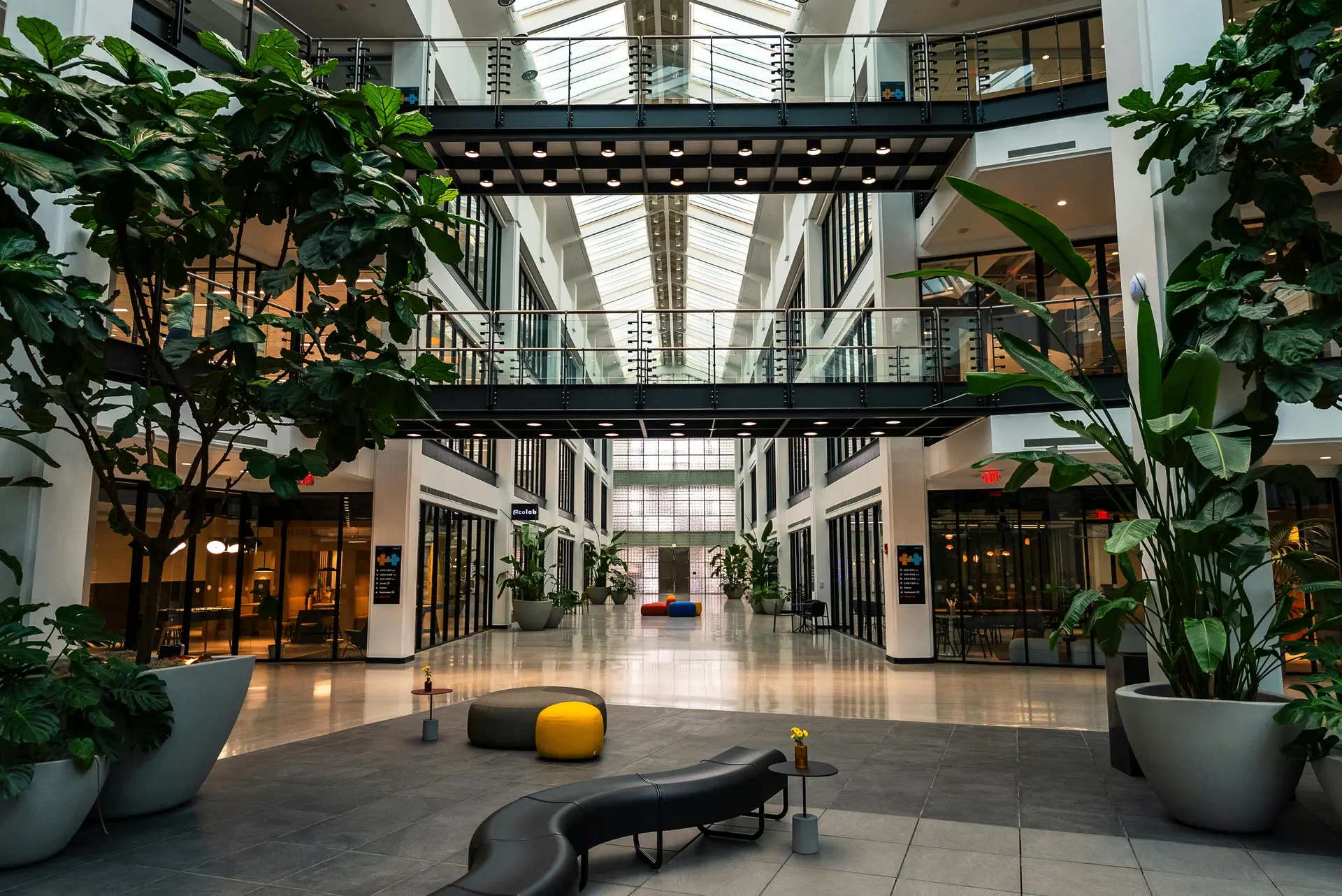
This guide covers what biophilic design is, why it works, and how to apply it in your office, whether you have a budget of 50 pounds or 50,000.
Biophilia means "love of life." The term was coined by psychoanalyst Erich Fromm in 1964, but Harvard biologist Edward O. Wilson made it famous in his 1984 book Biophilia. Wilson argued that humans have an innate, genetically encoded need to connect with nature. For over 99% of our evolutionary history, we lived outdoors. Our brains are still wired for natural environments.
Biophilic office design takes that idea and applies it to workplaces. It means deliberately incorporating natural elements into office spaces to support health, focus, and productivity.
Yale professor Stephen Kellert turned biophilia into a practical design framework. He identified three categories of biophilic experience:
In 2014, Terrapin Bright Green published 14 Patterns of Biophilic Design, which distilled over 500 research papers into a practical guide for architects and designers. A 10th-anniversary edition in 2024 added a 15th pattern: Awe.
The key principle across all these frameworks is that biophilic design must be repeated and sustained. A single potted plant on reception doesn't count. The nature connection needs to be woven throughout the space.
Two major theories explain why nature exposure helps us think and feel better at work.
Roger Ulrich's landmark 1984 study, published in Science, compared hospital patients recovering from surgery. Those with a view of trees spent nearly a full day less in hospital (7.96 days vs. 8.70), needed fewer painkillers, and received far fewer negative evaluations from nurses. His follow-up research showed that viewing natural settings after a stressful event produces measurable physiological recovery within about 4 minutes, including lower heart rate, reduced muscle tension, and decreased blood pressure.
Rachel and Stephen Kaplan at the University of Michigan proposed that our capacity for focused attention is a limited resource. When it runs out, we get mentally fatigued. Natural environments restore that capacity through what the Kaplans called "soft fascination," the effortless engagement triggered by moving clouds, flowing water, or rustling leaves. A 2008 study by Berman, Jonides, and Kaplan confirmed this experimentally: nature walks improved performance on attention-based cognitive tasks.
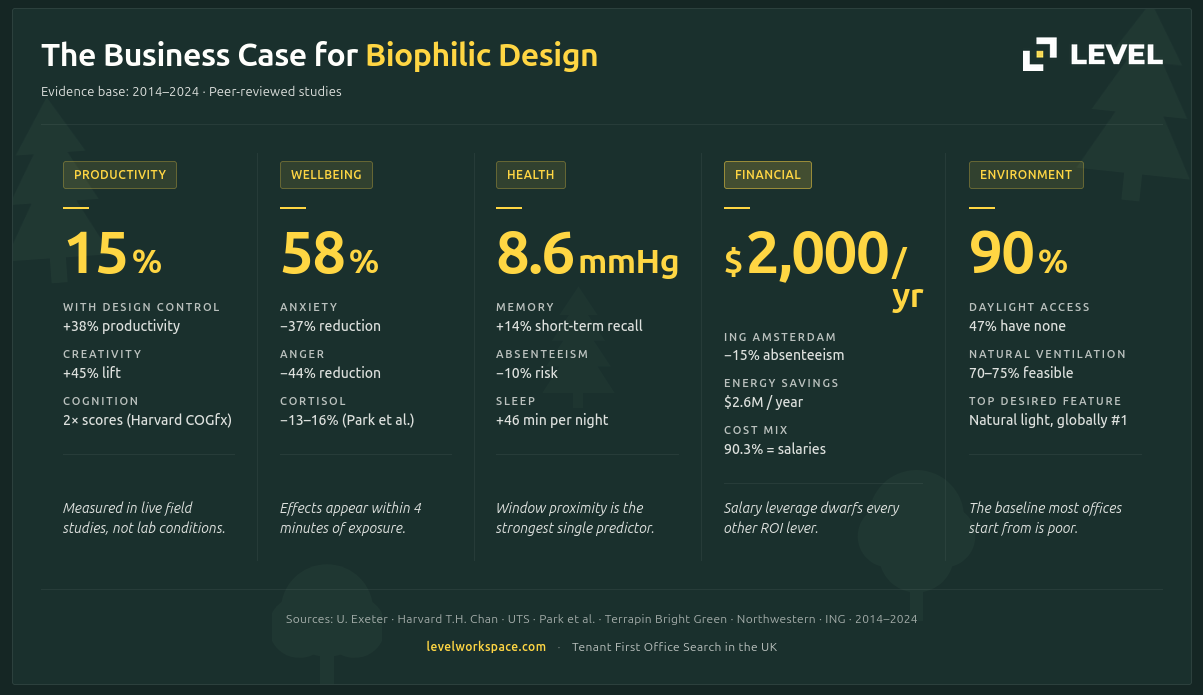
More recent research sharpens these findings. A Harvard study by Yin et al. (2018) found that biophilic indoor environments produced 8.6 mmHg lower systolic blood pressure, a 14% improvement in short-term memory, and lower skin conductance compared to non-biophilic settings.
Bratman et al. (2015) used brain imaging to show that 90-minute nature walks reduced activity in the subgenual prefrontal cortex, a brain region linked to rumination and depression. And a 2024 systematic review by Yildirim et al. analysing 74 peer-reviewed papers confirmed significant psychological, physiological, and cognitive benefits across workplace settings.
The science is solid. Nature in the office isn't just pleasant. It changes how our brains and bodies function.
Here's what the numbers look like when you put biophilic design into practice.
The University of Exeter ran three field experiments across UK and Dutch offices and found that simply adding plants to lean workspaces increased productivity by 15%. When employees were also given control over the design of their space, productivity rose by 38% and creativity by 45%.
Harvard's COGfx studies went further. Cognitive function scores doubled in green buildings compared to conventional ones. Crisis response scores were 97% higher and strategic thinking scores were 183% higher.
After ING Bank redesigned its Amsterdam headquarters with biophilic principles, absenteeism dropped 15% and the company saved an estimated 2.6 million dollars annually in energy costs. A University of Oregon study found that 10% of employee absences could be directly attributed to a lack of nature connection in the office, with window views being the strongest predictor.
Research by Park et al. (2010) showed that nature exposure reduced cortisol levels by 13 to 16%, increased parasympathetic nervous activity by 56%, and decreased sympathetic activity by 19%. The University of Technology Sydney found office plants reduced tension and anxiety by 37%, depression by 58%, and anger by 44%.
Terrapin Bright Green's Economics of Biophilia report makes a simple but powerful argument. Salaries account for 90.3% of total office costs per square foot. Energy accounts for just 0.8%. So even a small improvement in employee performance delivers a return that dwarfs any energy saving. Views of nature alone save over 2,000 dollars per employee per year.
If you're looking at the broader picture of how sustainable office space improves business outcomes, biophilic design is one of the highest-ROI investments you can make.
.jpg)
A living wall office installation is the most visually striking form of biophilic design. These vertical gardens use hydroponic, modular tray, or felt-based systems to grow plants on walls.
Popular species include pothos, philodendrons, peace lilies, snake plants, and various ferns. They are chosen for their ability to thrive in low-light indoor conditions.
Notable examples include Etsy's Brooklyn HQ, which features five large-scale living walls irrigated by a 3,400-gallon rooftop rainwater cistern, and the Desjardins Building in Quebec, which houses 11,000 plants across a 65-metre vertical garden.
Preserved moss walls are a practical alternative. They require zero irrigation, zero sunlight, and zero ongoing maintenance. They also provide excellent acoustic dampening, with a noise reduction coefficient of around 0.96. Over five years, a 100-square-foot preserved moss wall costs roughly 6,800 dollars total versus 47,500 for a living wall with maintenance.
Green Wall TypeCost Per Sq Ft (Installed)MaintenanceLifespanLiving wall (hydroponic)95 to 250 dollarsWeekly/monthly professional care10+ years with maintenanceModular tray system62 to 102 dollarsRegular watering, quarterly service8 to 15 yearsPreserved moss wall69 to 169 dollarsNone5 to 10 years
Indoor plants in the office are the simplest and cheapest starting point. You don't need a designer or contractor. Just add plants.
.jpg)
The 1989 NASA Clean Air Study showed certain houseplants could remove VOCs like benzene and formaldehyde in sealed chambers. However, a 2019 Drexel University meta-analysis found you'd need 10 to 1,000 plants per square metre to match what normal ventilation does for air quality. So plants won't purify your air in any meaningful way.
But that doesn't matter. The psychological benefits are real and well-documented. Plants reduce stress, improve mood, and increase productivity. The University of Exeter's research showed a clear 15% productivity boost just from adding greenery to an office.
Good choices for offices include:
Wood, stone, bamboo, and cork activate biophilic responses in ways that plastic and laminate don't. A study by Tsunetsugu et al. (2007) found that rooms with visible wood produced a 10% reduction in blood pressure, a 6% decrease in heart rate, and a 15% drop in stress hormones.
The key word is "visible." Painting over wood grain eliminates the biophilic effect. The texture and pattern of natural materials matters.
If a full sustainable office fit out isn't in the budget, start with smaller changes: wooden desk accessories, cork pinboards, stone planters, or wool and linen soft furnishings.
The sound of water does two useful things in offices. It calms people down, and it masks distracting conversations. Research shows that water sounds played at about 3 dB below speech level effectively mask office noise, and combining visual and auditory water features improved perception of the sound environment by up to 2.5 times.
Options range from small tabletop fountains (under 100 dollars) to architectural water walls (5,000 to 100,000+ dollars). Even a simple desk fountain can make a difference.
This might be the single most important element. A Northwestern University study found that workers near windows got 173% more light exposure during the day and slept 46 minutes longer at night compared to those in windowless spaces.
The Human Spaces Report confirmed that natural light is the number-one most desired workplace feature globally. Yet 47% of workers reported having no natural light at all.
Strategies include repositioning desks closer to windows, using glass partitions instead of solid walls, installing skylights, and removing unnecessary window obstructions. Circadian lighting systems that shift colour temperature throughout the day (warm in the morning, cool at midday, warm again in the evening) can supplement natural light where it's limited.
For more on how lighting and air quality connect to employee health, see our guide on workplace wellbeing and sustainable offices.
Under 500 pounds:
500 to 5,000 pounds:
5,000 to 50,000+ pounds:
Many of these improvements overlap with broader energy-efficient office buildings upgrades. Maximising daylight, for example, reduces both artificial lighting costs and the need for biophilic supplements.
This is where biophilic design projects succeed or fail. The most common reasons living walls die are surprisingly basic.
Irrigation failure causes roughly 90% of living wall failures, according to Scotscape. Insufficient lighting is the other big killer. Plants need a minimum of 200 foot-candles and about 8 hours of darkness daily.
Here's what ongoing care looks like:
Professional plant maintenance services typically run annual contracts at about 10% of the initial installation cost. For living walls, smart irrigation technology like the Hunter Hydrowise system allows remote monitoring and automatic scheduling, reducing the risk of under or overwatering.
Common office plant pests include fungus gnats (the most frequent), spider mites, and mealybugs. These are manageable with insecticidal soap, neem oil, and sticky traps. The key is catching problems early through regular inspections.
If maintenance feels overwhelming, preserved moss walls and hardy desk plants like snake plants and ZZ plants offer most of the biophilic benefits with a fraction of the upkeep.
.jpg)
Opened in 2018 and designed by NBBJ, the Spheres house over 40,000 plants from more than 400 species across 65,000 square feet of interconnected glass domes. Features include a four-story living wall with 25,000 plants and "Rubi," a 55-foot Ficus rubiginosa first planted in 1969. The space maintains a cloud-forest climate at 72 degrees Fahrenheit and 60% humidity.
Designed by Foster + Partners and certified LEED Platinum, Apple's 5-billion-dollar campus planted 9,000+ drought-resistant trees across 175 acres. The circular building achieves natural ventilation for 70 to 75% of the year through the world's first continuous curved glass facade. Every employee has access to outdoor views and daylight.
Designed by Gensler and opened in 2016, Etsy's headquarters earned Living Building Challenge Petal Certification, the largest such project globally at the time. The space includes 11,000+ plants, five living walls fed by rooftop rainwater, and every workstation sits within 41 feet of a window. Post-occupancy surveys showed 95% of employees felt the space reflected Etsy's values.
Designed by BIG and Heatherwick Studio and completed in 2022, Bay View provides daylight and outdoor views from every desk. The campus uses 100% outside air ventilation and evaluated approximately 3,950 materials against Living Building Challenge standards.
Built by Pete Nelson using reclaimed floating-house logs and charred cedar, these open-air treehouses intentionally have no screens or AV equipment. They're designed to encourage employees to step away from technology and think differently.
You don't need Amazon's budget to create a biophilic workspace. Start with what's cheap and proven: add plants, maximise daylight, and bring in natural materials where you can.
The research consistently shows that even small interventions deliver measurable results. A few desk plants can boost productivity by 15%. Repositioning workstations near windows improves sleep by 46 minutes a night.
If you're planning a larger project, think about maintenance from day one. The most common reason biophilic installations fail isn't bad design. It's neglected upkeep.
And remember that biophilic design is just one part of creating a sustainable office space. Combined with energy efficiency improvements, proper building certifications, and smart workplace wellbeing strategies, it becomes part of a workspace that's genuinely better for people and the planet.
Want to find your next leased, managed or serviced office space to rent? Book a call with our team today.


.jpg)