.png)

Back To Blogs
February 26, 2026
Joe Averill
10 minutes
Finding the right office space can make or break your business. Pick wrong and you're stuck with a costly lease that doesn't fit how your team actually works. Pick right and you've got a space that helps your company grow.
The UK flexible office market breaks records and just hit £2.02 billion in 2025 and is heading toward £3.09 billion by 2030. That growth tells us something important: businesses want options, not one-size-fits-all solutions.
This guide walks you through every type of office space available today. Whether you're a freelancer looking for a desk, a startup needing room to scale, or an established company reconsidering your headquarters, you'll find something that fits.
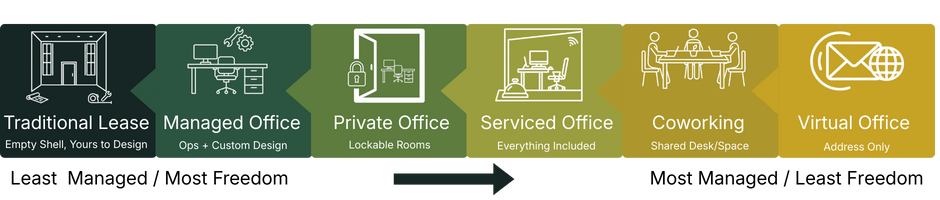
Before diving into details, here's how the main options stack up:
The best office depends on your specific situation. Here are the key questions:
How stable is your headcount?
How important is your brand in the space?
What's your budget situation?
How long can you commit?
→ Compare serviced office vs managed office vs lease in detail
Now let's break down each option.
A serviced office is move-in ready from day one. Desks, chairs, internet, reception, meeting rooms—it's all included in one monthly fee. You plug in your laptop and start working.
What you get:
The catch: You're in the provider's space with their branding. The reception will include their branding not your company name. Customisation is limited and often none.
Pricing:
Best for: Startups needing flexibility, companies testing new markets, satellite offices, and any business that wants simplicity over customisation.
Market reality: London occupancy sits at 88%. Serviced office supply grew 15%+ year-over-year from 2022-2024. And here's what's changed: 60%+ of flex transactions are now for 25+ desks. This isn't just for tiny startups anymore.
→ Learn everything about serviced office spaces
→ See our list of top 10 Best Serviced Offices in Manchester
Think of a managed office as the middle ground between serviced and leased. You get a blank canvas to design and brand as your own, but someone else handles the fit-out and ongoing building management.
The key difference from serviced: Your branding, your design, your front door. Visitors see your company name, not a flex provider's.
Pricing: Expect a 40% premium over serviced offices. Central London managed offices run £825-850/desk/month compared to £590-650 for serviced.
Best for: Growing companies that need brand presence without the commitment of a traditional lease. If you've got 25+ staff and want your own space but not a 10-year obligation, this is your sweet spot.
Market shift: 90%+ of flex operators seeking spaces over 20,000 sq ft now want management agreements rather than traditional leases. Managed offices have driven most of the flex market growth since 2022.
→ Discover if managed offices are right for you
This is the classic model. You rent empty space from a landlord, fit it out yourself, and manage everything. Total control, total responsibility.
What you're signing up for:
Lease types explained:
Full Service/Gross Lease: One rent payment covers most expenses. Higher monthly cost but predictable.
Net Lease: Lower base rent, but you pay a share of operating costs on top.
Triple Net (NNN): Lowest rent, but you pay everything—rent plus taxes, insurance, and maintenance.
Pricing:
Best for: Established businesses with stable operations, companies needing complete brand control, and organisations with capital for upfront investment.
Trade-off summary: Lowest long-term cost per square foot and total customisation freedom. But you're locked in, upfront costs are substantial, and getting out is expensive if things change.
Recent trend: Average lease lengths increased 27% to 3.7 years in Q1 2024. Businesses aren't running from commitment—they're just being more selective about when to make one.
Coworking isn't just an office—it's a community. You work alongside freelancers, startups, and remote workers from other companies. The best spaces offer networking events, introductions, and a sense of belonging that working from home can't match.
Your options:
Hot Desk: Grab any available desk. Cheapest option but no guaranteed spot.
Dedicated Desk: Your own permanent desk in the open space. Leave your stuff overnight.
Private Office: A lockable room within the coworking space. Privacy plus community access.
Pricing:
Best for: Freelancers, solo entrepreneurs, remote workers escaping home isolation, early-stage startups (1-5 people), and corporate employees who only need occasional office access.
The honest trade-off: Great for networking and the lowest flexible entry point. But privacy is limited, noise levels vary, and atmosphere depends heavily on who else is there that day.
A virtual office isn't actually an office. It's an address, mail handling, and optionally a phone number answered in your company name. You work from home (or anywhere) while maintaining a professional business presence.
Service tiers:
Best for: Home-based businesses wanting a professional image, international companies establishing UK presence, freelancers protecting home address privacy, and startups needing a registered office before physical space.
Important limitation: You can't use a virtual office address for VAT registration. And savvy clients may recognise the address as a known virtual office provider.
This is a lockable room inside a coworking space or business centre. You get the privacy and security of your own office while accessing shared amenities and the broader professional community.
Sizing and pricing:
Note: Larger offices have lower per-desk costs. And 50+ person availability contracted 7.7% in Q3 2025—bigger teams are snapping up these spaces.
Best for: Small teams wanting privacy plus community, confidential work requiring a lockable door, and businesses outgrowing hot desking but not ready for a full serviced office commitment.
→ Learn more about private offices
A hot desk is exactly what it sounds like—you grab any available desk when you arrive. The name comes from naval "hot bunking" where sailors on different shifts shared beds that stayed warm from the previous person.
How it works: No booking required. Show up, find an empty desk, work. At the end of your session, clear your belongings. Personal items go in a locker.
Typical costs: £100-250/person/month. London runs higher at £200-400. Day passes usually £15-40.
Best for: Hybrid teams needing occasional office access, employees splitting time between home and office, freelancers wanting variety, and businesses testing coworking before committing to dedicated space.
The reality check: This is the cheapest flexible option, but you might spend time hunting for a desk. No personalisation, no guaranteed spot, and not suitable for confidential work.
Sublet space comes from another company, not directly from a landlord. When businesses downsize, adopt remote work, or simply overestimated their needs, they rent out excess space—often at a discount.
Why it's attractive:
The limitations: Your term is tied to the original tenant's lease. You have less negotiating power. And if the original tenant's lease ends or their relationship with the landlord sours, you might need to leave.
Best for: Businesses needing space immediately, companies wanting shorter commitments at discount rates, and startups looking for quality space below market price.
Post-pandemic opportunity: Sublet availability jumped as companies adjusted to hybrid working. Quality Grade A sublets in prime locations can offer exceptional value right now.
→ Learn more about shared office spaces
Executive suites are the premium tier of serviced offices. Think high-end finishes, Mayfair addresses, dedicated concierge service, and the kind of meeting facilities that impress clients.
What sets them apart:
Pricing: £800-1,500+/desk/month. Premium London addresses sit at the upper end.
Best for: C-suite executives, professional services firms (law, finance, consulting), client-facing roles where appearance matters, and international executives needing impressive London presence.
Honest assessment: This is the highest-quality serviced experience available. But the premium pricing may be excessive for non-client-facing teams, and top locations have limited availability.
Hybrid offices are designed specifically for teams that split time between home and office. Instead of assigning everyone a desk, these spaces operate at ratios of 1:1.5 to 1:3—more employees than desks.
What makes them different:
Typical cost: £250-500/person/month. Lower per-person than traditional offices because of desk sharing, but higher investment in collaboration spaces and technology.
Best for: Companies with formal hybrid policies (2-3 office days per week), organisations reducing their real estate footprint, and teams where focused work mostly happens at home.
The challenge: This requires cultural change. Some employees resist losing "their" desk. And without robust booking systems and clear protocols, it can create friction.
Market context: 72% of UK employers now offer hybrid or remote work. Demand for hybrid-ready spaces is driving the flight to quality—80% of 2023-24 take-up was Grade A/prime space.
→ How to design an office layout for hybrid teams
Beyond the type of office, the amenities available can make a significant difference to your team's productivity and wellbeing. Here are the key facilities to look for:
For Active Commuters:
For Health & Wellness:
For Lifestyle Needs:
When comparing offices, don't just look at the desk — consider the full package of amenities that will help your team thrive.
Office design has changed dramatically over the past century. Understanding where we've been helps explain the options available today.
The Factory Floor Era (Early 1900s) Early offices looked like production lines. Rows of identical desks. Managers watching from above. Workers treated as interchangeable parts. Frank Lloyd Wright's Johnson Wax Headquarters in 1939 was one of the first purpose-built open plan offices—and it set a template that lasted decades.
The Cubicle Revolution (1960s-1990s) Robert Propst designed the Action Office for Herman Miller with good intentions: give workers privacy, standing desks, and space to personalise. But corporations saw something else—a way to pack more people into less space. The result? Cubicle farms that Propst himself called "monolithic insanity."
The Open Plan Revival (2000s) Tech companies tore down the walls. Google, Facebook, and countless startups embraced open layouts as symbols of collaboration and innovation. The reality? Harvard research found open plans actually reduce face-to-face interaction by up to 70%. Workers retreat to headphones and Slack instead.
Post-Pandemic Reality (Now) COVID-19 finished what was already starting. The question shifted from "where do we work?" to "why come to the office at all?" Today's best offices earn visits by offering what home can't: collaboration spaces, professional amenities, and human connection.
The UK office market offers more options than ever. From traditional leases for established headquarters to hot desks for hybrid teams, there's a solution for every business size, budget, and working style.
The right choice depends on your specific situation—how fast you're growing, how important branding is to your clients, what you can commit to financially, and how your team actually works day-to-day.
Don't just compare headline prices. A £400/desk serviced office might cost more than a £70/sq ft lease—or it might cost less once you factor in fit-out, furniture, utilities, business rates, and the flexibility to leave when you need to.
👉 Model these options in LEVEL's Office Cost Calculator to see true 5-year costs, including hidden expenses.
And if navigating all these options feels overwhelming, you don't have to do it alone. Working with an office broker can save you time, money, and the headache of comparing dozens of spaces yourself—at no cost to you.
Market Data:
Government/Independent:
Want to find your next leased, managed or serviced office space to rent? Book a call with our team today.


.jpg)